Mission Statement
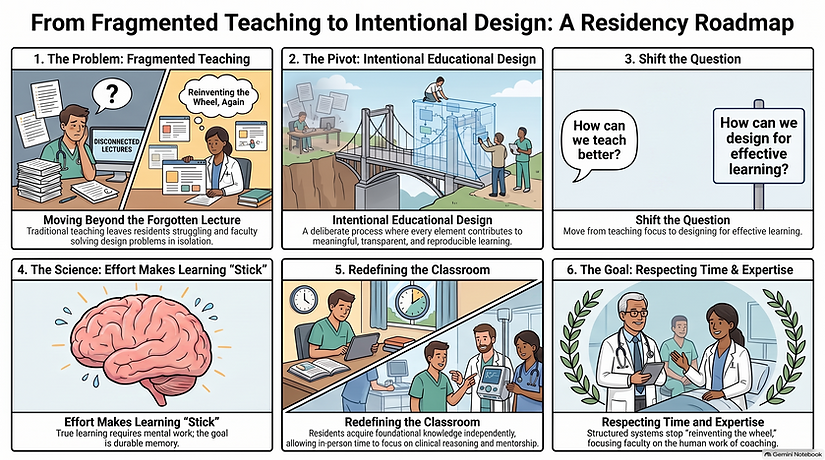
This project began with a simple question: Why weren’t the educational experiences I worked so hard to create producing the learning I hoped they would? As both a resident and later a faculty educator, I experienced the same frustrations from different perspectives. Residents struggled to prepare, lectures were quickly forgotten, and educational activities often felt disconnected from one another. I realized that once I created a lecture, it often remained unchanged for years.
I started asking myself questions:
-
Has another physician designed a better educational experience for this topic?
-
Is this lecture effectively teaching this subject?
-
Are residents retaining what I teach?
These experiences and self-reflection led me to study the science of learning and ultimately to ask a different question—not “How can we teach better?” but “How can we intentionally design universal educational experiences that help residents learn more effectively?”
Residents are in a unique stage of medical education. They are simultaneously learners, physicians, and teachers. While providing patient care and assuming increasing clinical responsibility, they must also continue to acquire, retain, and apply an ever-expanding body of medical knowledge. This requires educational experiences that are not only rigorous, but also intentionally designed to help residents learn as efficiently and effectively as possible.
Faculty are educators, clinicians, mentors, coaches, and role models. They teach while balancing the demands of patient care, supervision, scholarship, administration, and their own professional development. They should not have to repeatedly solve the same educational design problems in isolation. Thoughtfully and intentionally designed educational systems should support faculty by providing structure, guidance, and resources that allow them to focus on the uniquely human work of teaching, mentoring, and developing future physicians.
These systems should be easily accessible and implemented. These systems should provide a reproducible foundation for high-quality educational experiences across residency programs while allowing educators to apply their individuality, expertise, and clinical experience.
We should respect and honor the time and commitment of both residents and faculty by ensuring that every in-person educational experience is meaningful and memorable.
This Mission Statement begins with a simple belief: Learning—and the educational experiences that support it—deserve thoughtful and intentional design.
Intentional educational design is the deliberate process of creating educational experiences in which every element exists for a reason and contributes to meaningful learning.
An intentionally designed educational system should also be transparent. Residents, faculty, and residency programs should understand not only what each component is designed to accomplish, but why it exists, how it supports learning, and how each intentional design choice contributes to meaningful education.
The educational strategies within this methodology are grounded in the science of learning and adapted to the realities of residency education.
Intentional educational design extends beyond the delivery of medical knowledge. It also seeks to help residents understand how to learn, why educational experiences are designed as they are, and how to become increasingly effective, independent learners throughout their professional lives.
Learning is difficult work; it should remain so. As Peter Brown writes in “Make it Stick: The science of successful learning”: “We’re easily seduced into believing that learning is better when it’s easier, but the research shows the opposite: when the mind has to work, learning sticks better.” The goal of intentional educational design is not to remove the effort required for learning, but to ensure that effort results in durable memory.
Residents should devote their independent study to acquiring foundational knowledge, while in-person educational experiences should focus on applying that knowledge through discussion, clinical reasoning, case-based learning, and the insights that experienced faculty bring through mentorship and patient care.
Residency programs should be able to implement a cohesive educational system designed by experts from across the country. Residents should genuinely want to engage with the curriculum because it consistently demonstrates respect for their time and meaningfully enhances their learning.


